Does Your Senior Living Organization Have a “Vintage” Care Model?
Quick answer: A “vintage” care model waits for families to be ready to move in before offering help. Modern senior living organizations extend home care into families’ homes before move-in—capturing revenue, protecting their brand, and building continuity of care that lasts a lifetime. The product isn’t broken; the delivery model is overdue for an upgrade.
Same Mission. Better Delivery.
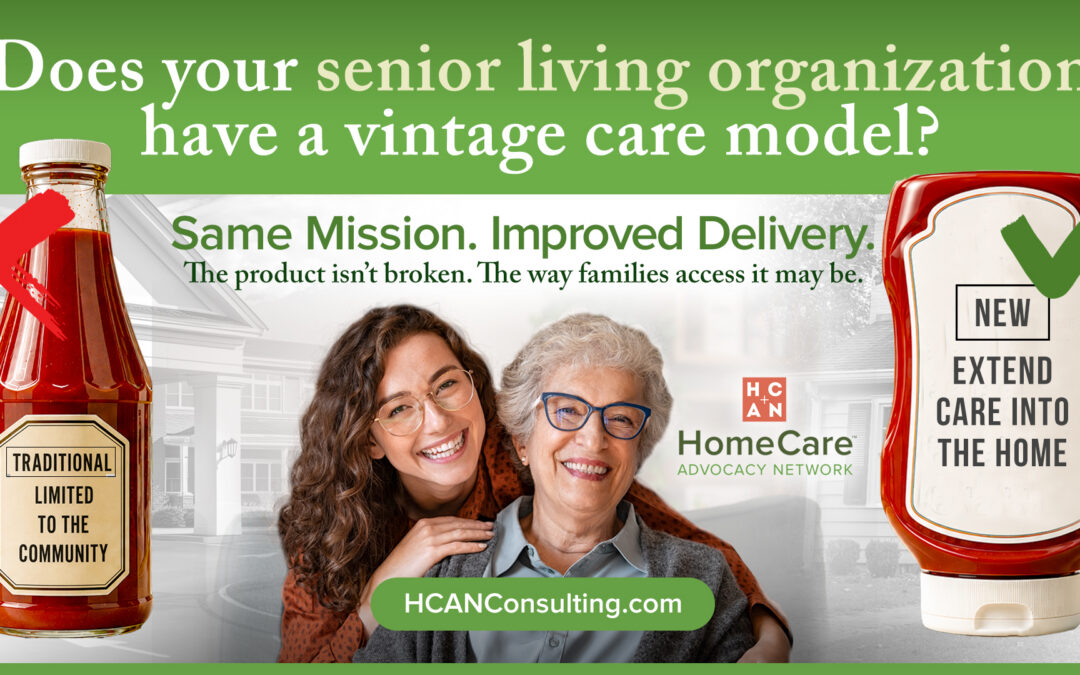
Think back to the old glass ketchup bottle. The ketchup inside was perfect—rich, flavorful, exactly what people wanted. But getting it out meant slapping the bottom of the bottle, waiting, and hoping. The product was never the problem. The delivery was.
Many senior living organizations face the same situation today. The care they provide is excellent. Their mission is sound. Their communities change lives. Yet the way that care reaches families—the delivery model—may belong to another era.
This post makes the case that the aging journey no longer begins at your front door, and that senior living organizations clinging to a “when you’re ready, we’re ready” approach are quietly handing trust, demand, and future residents to competitors. Below, we examine why a modern senior living home care strategy starts in the family’s kitchen, how a true home care business differs from a box-checking program, and what continuity of care in senior living should really mean.
The Product Isn’t Broken. The Delivery Model May Be.
Let’s be clear about what’s working. The care senior living organizations deliver is genuinely good. Residents thrive. Families find peace of mind. Missions get fulfilled every single day.
So this is not a critique of the product. It’s a challenge to the delivery model.
For decades, the industry operated on a simple promise: “When you’re ready to move in, we’re ready to serve you.” That model made sense in its time. Families researched communities, toured campuses, and eventually moved in when the need became urgent.
But consumer behavior has shifted. Waiting at the front door for families to arrive—like slapping the bottom of that ketchup bottle—assumes the delivery method still fits the moment. It often doesn’t.
Where Does the Aging Journey Really Begin?
Here’s the reality most executives already sense: the aging journey no longer starts at your community’s entrance. It starts months, often years, earlier.
Picture the actual moment of decision. It usually happens at a kitchen table. An adult daughter sits with a cup of coffee, worried about Mom. Mom isn’t ready to leave her home. She may never want to. But she needs help—and she needs it now.
That kitchen table is the new front door.
According to an HCAN survey, more than 95% of prospective residents said they are very or somewhat interested in home care services offered before move-in. Even more telling, 85% said in-house home care positively influences their decision to choose a community.
Families are raising their hands earlier than ever. The question is whether your organization is there to answer—or whether someone else is.
What Is the Hidden Cost of Referring Families Elsewhere?
When a family asks for help before they’re ready to move, many senior living organizations respond with a well-meaning gesture: they hand over the name of an outside home care agency.
It feels helpful. It’s actually costly.
Consider exactly what that single referral surrenders:
- The trust you built. Decades of reputation, marketing, and community goodwill get transferred to another brand the moment you make that recommendation.
- The demand you created. Your sales and marketing investment generated that inquiry. Referring it out turns your pipeline into a competitor’s revenue.
- Your future residents. Here’s the quiet danger. That family bonds with the caregiver already sitting in their living room. When Mom finally is ready to move, she may follow that relationship—straight to a different community.
You didn’t just lose a home care client. You may have lost a future resident, along with the years of revenue and referrals that resident represents.
Since 86% of all home care revenue comes from referrals by providers like senior living communities, referring families out means funding your competition with the very demand you worked to create.
A Home Care Program vs. a Home Care Business: What’s the Difference?
“We already have home care.”
It’s the most common response we hear—and often the most misleading. Having a home care program is not the same as running a home care business. The distinction is strategic, and it determines whether your organization competes or simply checks a box.
| Home Care Program | Home Care Business |
|---|---|
| Built as an ancillary, campus-bound service | Community-facing and brand-extending |
| Managed on the side of a desk | Dedicated recruiting, sales, marketing, and systems |
| Solves the problem of saying “yes, we have it” | Competes, scales, and generates revenue |
A home care program answers a question. A home care business wins a market.
Why does this distinction matter for senior living leaders?
A program that only serves current residents on campus can’t meet families at the kitchen table. It has no way to reach the daughter worried about Mom who lives three towns away. It exists to say “yes, we offer that”—and little more.
A true home care business, by contrast, is a scalable revenue stream and a new starting point for lifelong resident relationships. It has its own recruiting engine, its own sales and marketing motion, and the operational systems to grow. That’s what makes home care for senior living organizations a competitive advantage rather than an afterthought.
What Should Continuity of Care Really Mean?
The industry loves the phrase “continuity of care.” Too often, it means continuity that begins only once someone moves in.
Real continuity of care in senior living starts earlier. It begins the first time your team walks into a family’s home—when Mom needs just 12 hours of help a week—and continues seamlessly through the eventual move to your community, assisted living, and beyond.
When a family has known your caregivers for a year before move-in, they aren’t starting a relationship. They’re continuing one.
That’s continuity of care in its truest sense: one trusted brand, one care team, one relationship that grows with the resident’s needs over time.
A New Path Forward for Senior Living
The good news is that this shift is achievable, and it’s already happening.
Consider White Horse Village, a premier Life Plan Community in Newtown Square, Pennsylvania. White Horse Village already had home care. But its leadership recognized a bigger opportunity—not just to serve residents on campus, but to serve future residents still living in their own homes.
Partnering with HCAN, White Horse Village developed a “care anywhere” model. Today, that model serves both current residents on campus and future residents in their own homes, some needing as little as 12 hours of care each week.
Here’s the strategic payoff: when those individuals eventually decide to move, they aren’t beginning a relationship. They’re continuing one. The trust is already built. The care team is already familiar. The choice of community is already made.
That is a senior living home care strategy designed for how families actually make decisions today.
How can your organization make the shift?
Modernizing your delivery model doesn’t require abandoning your mission. It requires extending it. Three steps move you forward:
- Assess your current model honestly. Determine whether your organization operates a box-checking home care program or a competitive, community-facing home care business. Be candid about the gap.
- Move your front door into the home. Build the capability to serve families the moment they raise their hand—under your own brand, with your own care team. Meet them at the kitchen table.
- Engage a proven partner. Work with a specialist to develop, launch, and sustain a home care business built to today’s standards and aligned with your mission. Explore how HCAN’s partnership model supports this transition.
Separate Nostalgia from Strategy
The ketchup was always good. The bottle just needed to change.
The same is true for senior living. The care is excellent. The mission matters. But a delivery model that waits at the front door—while families make decisions at the kitchen table—leaves trust, revenue, and future residents on the table.
Senior living organizations that separate nostalgia from strategy will be the ones positioned to protect their brand legacy, capture new revenue, and lead their markets. Same mission. Better delivery.
If you’re ready to examine whether your organization runs a home care program or a home care business, schedule a conversation with HCAN. We’ll help you assess your current model and map a path to a home care business built for the way families age today.
Frequently Asked Questions
What is a “vintage” care model in senior living?
A “vintage” care model is one built on the promise, “When you’re ready to move in, we’re ready to serve you.” It waits for families to arrive at the community rather than meeting them earlier in the aging journey. The care itself may be excellent, but the delivery model no longer matches how families make care decisions today—often months or years before a move-in.
Why should senior living organizations offer home care before move-in?
Families begin making care decisions long before they consider moving. According to an HCAN survey, more than 95% of prospective residents are interested in home care offered before move-in, and 85% say in-house home care influences their community choice. Offering home care early lets an organization build trust, capture revenue, and secure future residents before a competitor does.
What’s the difference between a home care program and a home care business?
A home care program is an ancillary, campus-bound service managed on the side of a desk—its main purpose is to say “yes, we offer that.” A home care business is community-facing and brand-extending, with dedicated recruiting, sales, marketing, and systems. A business competes, scales, and generates revenue; a program simply checks a box.
What does continuity of care mean in senior living?
True continuity of care begins the first time your team enters a family’s home—sometimes for as little as 12 hours of care a week—and continues seamlessly through move-in, assisted living, and beyond. When families know your caregivers before they move in, they continue an existing relationship rather than starting a new one.
How does HCAN help senior living organizations expand into home care?
HomeCare Advocacy Network (HCAN) is a home care company with a model tailored specifically to senior living providers. HCAN helps organizations develop, launch, and sustain a community-facing home care business—covering recruiting, sales, marketing, and operational systems—as demonstrated in its partnership with White Horse Village. Learn more on HCAN’s partnerships page or schedule a consultation.